


Last week, the Trump administration killed 11 civilians in a military strike on a small speed boat in international waters in the southern Caribbean. The administration claims, but has offered no evidence, that those killed were involved in drug trafficking and members of a Venezuelan gang the Trump administration has designated as terrorists. In a War Powers report to Congress, the administration has warned that further military actions are likely. Some officials have made clear the White House is not only pursuing drug enforcement but wants regime change in Venezuela as well.
The extrajudicial killings mark the troubling convergence of three tendencies within the Trump White House: the use of military force without Congressional authorization; the use of national security and wartime powers for routine criminal matters or immigration enforcement; and escalating tensions between the U.S. and Venezuela.
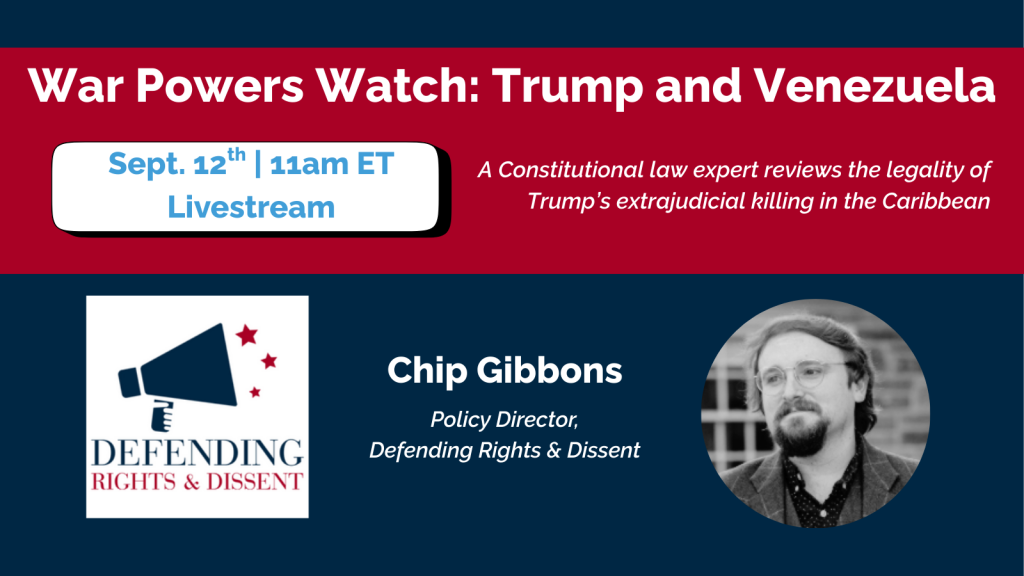
On Friday, September 12th, Defending Rights & Dissent Policy Director Chip Gibbons, an expert on both U.S. Constitutional law and the history of the U.S. national security state, discussed the legality of Trump’s military action, reviewing how it violates the U.S. Constitution, the significance of Trump’s terrorism designations, and how Trump’s strikes in the Caribbean compare to past military actions, such as Obama’s drone killings.
