


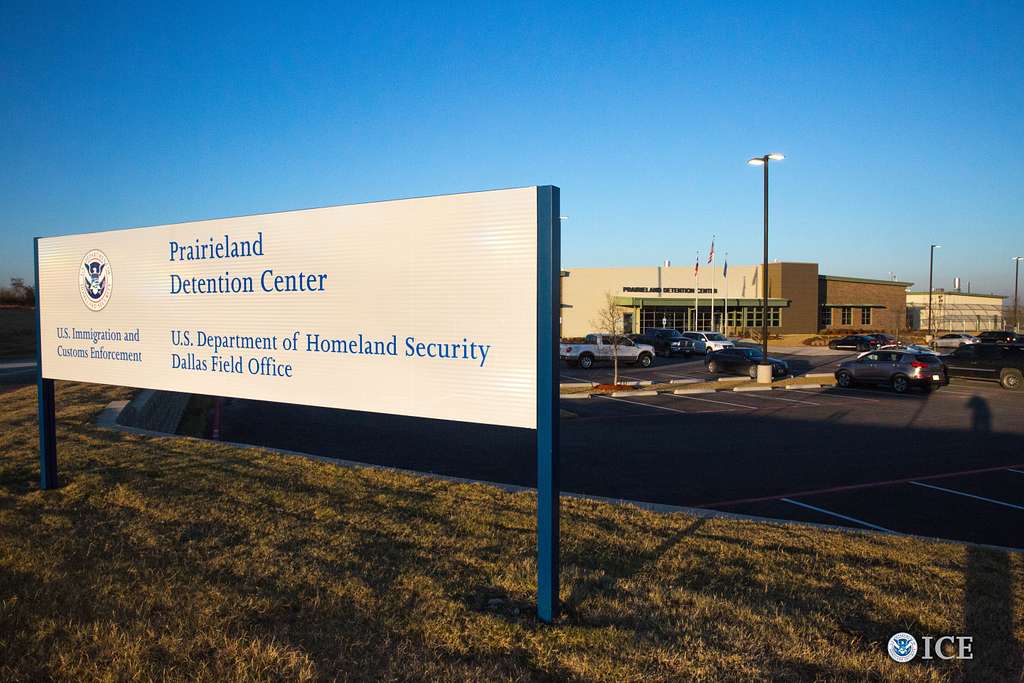
Last week, two federal judges in Texas sentenced eight activists to 30 to 100 years in prison for actions related to a July 4, 2025 protest at the ICE Prairieland detention center.
Defending Rights & Dissent Policy Director Chip Gibbons spoke to The Guardian about the prosecution of the participants in the anti-ICE noise demonstration as terrorists, stating “It is not only an attempt at chilling speech, but an indication that [the Trump administration is] going to continue going after protests extremely hard.” Gibbons, who is the author of The Imperial Bureau: The FBI, Political Surveillance, and the Rise of the U.S. National Security State, a forthcoming new history of the FBI which traces the throughline from McCarthyism to the development of modern counterterrorism, noted the historical context of the prosecutions, arguing:
There’s a long history in the U.S. of trying to claim that anarchists or communists, or other -isms on the left, are engaged in criminal conspiracies, and then conflating their activism with those so-called conspiracies, casting a wide net to equate speech with violence or critical acts.
The prosecution stemmed from an incident that occurred during a July 4, 2025 noise demonstration. Anti-ICE protesters set off fireworks outside an immigrant detention center in Alvarado, Texas. According to the participants, this was a noisy but peaceful act of protest intended to show solidarity with the immigrant detainees inside the facility. Following the protests, a number of the activists ran away. One participant, Benjamin Song, claims he witnessed a federal law enforcement officer draw his gun. According to him, he believed the officer intended to kill a protester, and he fired at the officer, grazing him. The Department of Justice took a very different view of the situation, arguing Song attempted to murder a federal official. A jury convicted him of this charge.
The Trump Department of Justice did not stop at Song. They also brought charges against other individuals, both present and not present at the demonstration. Those present maintained they were merely there to take part in a peaceful protest and had no foreknowledge or involvement in the shooting. The Trump DOJ casts all of the defendants as being part of a so-called “Antifa cell,” who organized together for a nefarious purpose. Antifa is short for anti-fascist and refers to an ideology, not a group. Nonetheless, much like how in the past federal officials see a hidden Communist hand behind everything, the Trump administration has pushed the false claim that Antifa is an organization, promulgating conspiracy theories that they are behind various domestic acts. In order to convict the individuals of terrorism related charges, the Department of Justice employed guilt-by-association tactics and entered evidence of political associations to transform them into criminal accomplices. The use of shared political ideology to establish shared criminal liability is a criminalization of speech. All of the activists received unusually lengthy prison sentences that appear rooted in political animus. Disturbingly, one activist, Daniel “Des” Sanchez Estrada, was sentenced to 30 years in prison simply for transporting political literature, arguing he was “corruptly concealing documents.” Estrada was not present at the demonstration.
The Trump administration has openly touted this case as an “Antifa” prosecution and made it a centerpiece in their drive to crackdown on political dissent broadly. Trump cited the case in his National Security Presidential Memorandum-7 (NSPM-7) as justification for the memo’s policies. As Gibbons has previously demonstrated, NSPM-7 is a blueprint for a wider crackdown on the left that draws on existing counterterrorism police.
In April, when the defendants were convicted, Defending Rights & Dissent hosted an online panel event with the National Lawyers Guild, moderated by by NLG’s mass defense attorney Xavier T. de Janon and featuring Gibbons, Freedom of the Press Foundation’s Seth Stern, and Dario Sanchez, a state-level defendant in the case.

In May, we hosted another event breaking down NSPM-7, featuring Gibbons, former FBI agent Terry Albury, and investigative journalist Spencer Ackerman, in a discussion hosted by Drop Site News’ Murtaza Hussain.

Defending Rights & Dissent has decades of experience in documenting, exposing, and challenging the use of counterterrorism and national security powers to stifle First Amendment freedoms. Currently, we are using that expertise to educate Congress, journalists, and the public about the dangers of NSPM-7 and how it builds on decades of existing national security powers to target political dissent. Consider donating to support that work.